

What makes a superapp?
Our methodology for pinpointing superapp potential
For our analysis, we looked at every firm on FinTech Insights' database and grouped their functionalities into five categories:
-
Core banking
These include account-opening and management, bill payments, direct debits, transfers, and P2P functionality, cards, ATM and cash services, and statements.
-
Extended financial services
These are services that, while commonly offered, particularly by legacy banks and credit unions, aren't strictly core banking services. They include savings, investments, wealth management and personal finance management, personal lending, mortgages, and multi-currency services.
-
Everyday payments
This category includes merchant payments, payments via QR codes, travel card and mobile top-ups, and subscriptions.
-
Lifestyle
Here, we've included mobility spend, such as bus fares, train tickets, and flights, accommodation, eSims, and event tickets.
-
Ecosystem
These include access to a partner marketplace, rewards, embedded services, and a network of mini-apps or integrated external providers.
We consider the Lifestyle category to be the strongest indicator of a shift toward superapp status, because it catches apps that have clearly expanded beyond traditional banking without raising the bar too high.
The Ecosystem category is arguably the final state: a banking app that has fully evolved into a superapp. At the time of writing, however, the features in this category remain uncommon, which is why it's not our key indicator. Had we made it so, several apps that are no longer "just" banking apps would've been excluded.
The nine firms with superapp potential
When we assessed the firms in FinTech Insights' database against the five categories, nine emerged as either moving towards or being close to achieving superapp status.
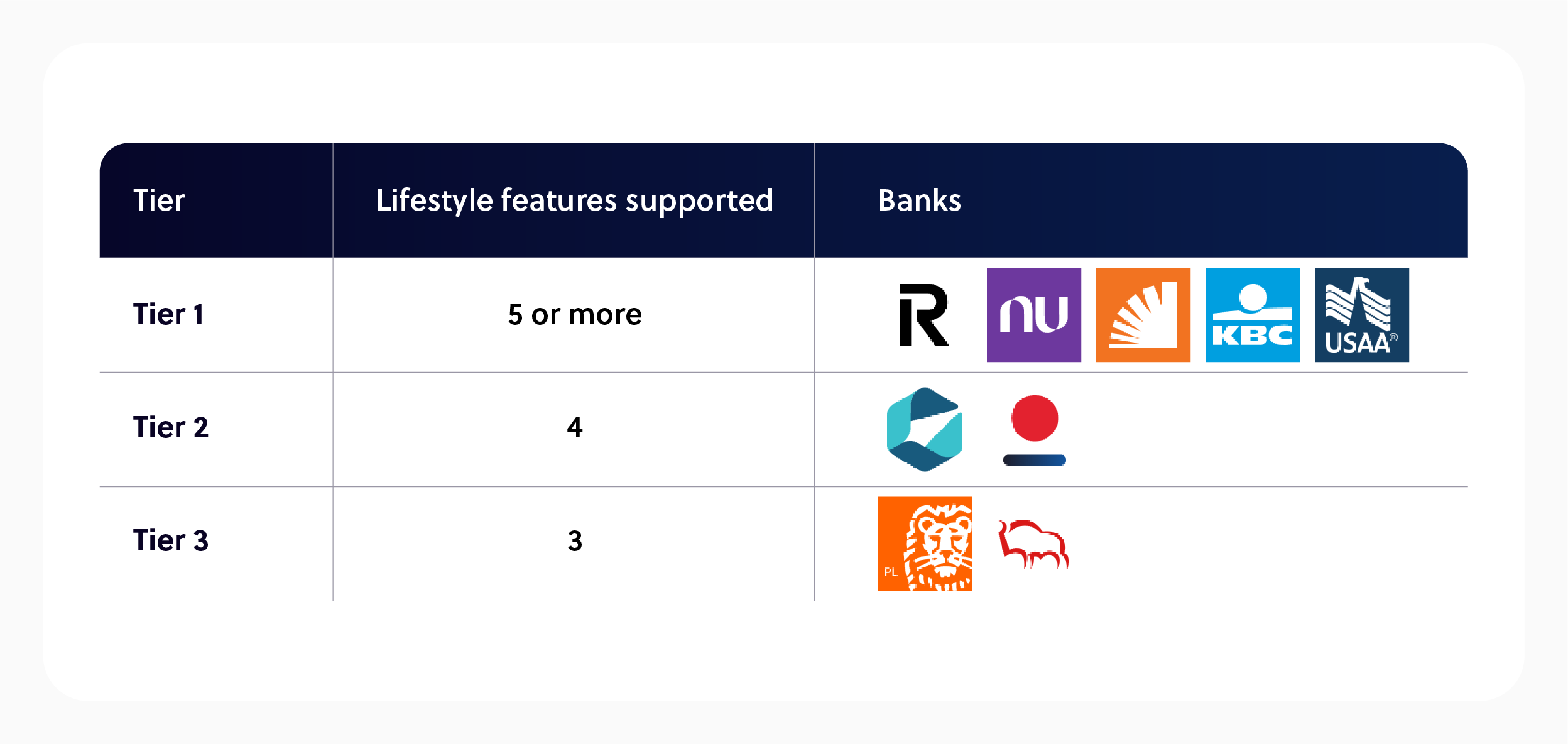
We grouped these into three tiers, based on how many features in the Lifestyle category they support:
- Tier 1 apps support five or more. These are: Revolut, Nubank, Inter, KBC, and USAA
- Tier 2 apps support four Lifestyle features. They are: Citadel CU and PKO BP
- Tier 3 apps support three Lifestyle features. They are: ING and Bank Pekao
KBC is both a standout and a notable exception.
It supports 11 Lifestyle functionalities — more than double those supported by other Tier 1 apps. These include bus tickets, bike rental, parking, refueling, cinema tickets, football alerts, and even job ads.
The flipside is that KBC is one of only two firms — the other is ING — that doesn't support any Ecosystem features.
The breadth of Lifestyle features and absence of Ecosystem ones suggests KBC's strategy is to own the day-to-day: from mundane moments like commuting to major milestones like the next career step.
One key focus, nine very different strategies
Once you take KBC out of the equation, the Lifestyle category is more homogenous than it first appears.
Revolut, Nubank, Inter, USAA, and Citadel CU's Lifestyle offerings are built on travel-related features. The key differences between them lie in their approaches.
Revolut emerges as a travel specialist. Adding airport lounge passes, booking hotels, buying mobile data and bus tickets, and travel tips, largely focus on a very specific moment: going abroad.
Seeing as, when it started out, Revolut's key use case was multi-currency spending, this isn't surprising.
By contrast, PKO BP, ING, and Bank Pekao — all three are Polish banks — focus primarily on everyday mobility.
Buying bus tickets, paying for tolls, parking, and vehicle tags, and, in the case of PKO BP, buying cinema tickets are nominally low-value purchases. But they're also high-frequency actions, which suggests their strategy is to embed their app into users' daily routines.
Nubank and Inter's key differentiators are their ecosystem capabilities. With four each, they have the highest number of Ecosystem functionalities from the nine firms we identified. Both enable users to access online stores via their app.
That said, Nubank delivers a more complete e-commerce journey by also making it possible to track a purchase.
There are many roads to superapp-dom
Elon Musk famously declared that he wants X to be an "everything app".
But, in the digital banking space, FinTech Insights' data shows that there's more than one route to becoming a superapp. And, more to the point, the approach you take can become a strong competitive differentiator.
Far from doing "everything", being intentional about which areas beyond banking to expand to and which everyday moments to own enables you to embed yourself into consumers' lives in the ways that matter most to them.
Want to dive deeper into which competitors in your market are moving beyond banking?
Evaluate their strengths and weaknesses and benchmark your app on FinTech Insights.

Build a digital banking strategy that can't be challenged
Let's show you how FinTech Insights can help you wow your customers, on every login.