

Santander's route to the US market
Santander took a longer, more circuitous route to US entry than most of its European counterparts.
Its first foray across the pond was in Latin America in the 1990s, through strategic acquisitions in Mexico, Chile, and Argentina — countries with which, as a Spanish bank, it has deep cultural, linguistic, and historical ties — and in Brazil.
While these acquisitions didn't give Santander direct access to the US, they helped lay the groundwork. When the bank entered the US in the 2000s, once again through strategic acquisitions, it did so with scale, capital, and experience under its belt.
Santander's US primary retail banking vehicle was Sovereign Bank, which it acquired and rebranded gradually between 2006 and 2009. The bank also entered the US' highly lucrative $1.5 trillion car finance industry.
Rather than building a branch-led model from scratch, Santander operated through local subsidiaries. This gave the bank access to existing licenses, local deposits, and established regulatory relationships, and made it possible to run US operations through distinct entities with their own oversight and capital planning.
Instead of trying to do too much at once, the bank also kept its focus firmly on its core business: everyday retail banking.
By contrast, Monzo's route to the US market began with a false start: a banking charter application which they withdrew when it became clear that it wouldn't be approved. Monzo then continued its operations via a partner-banking model.
As in an acquisition scenario, the partner-bank approach has the advantage of access to an established bank's infrastructure and expertise. But it also has the significant drawback of less control over the product lineup.
In Monzo's case, this resulted in their US app lacking important functionalities such as remote deposit capture — checks remain an important payment method in the US — and P2P payments, which are the only way US consumers can transfer money in real time.
Because Santander entered via acquisition, it had much more control over its product lineup, feature set, and operating model.
How does Santander's banking app stack up?
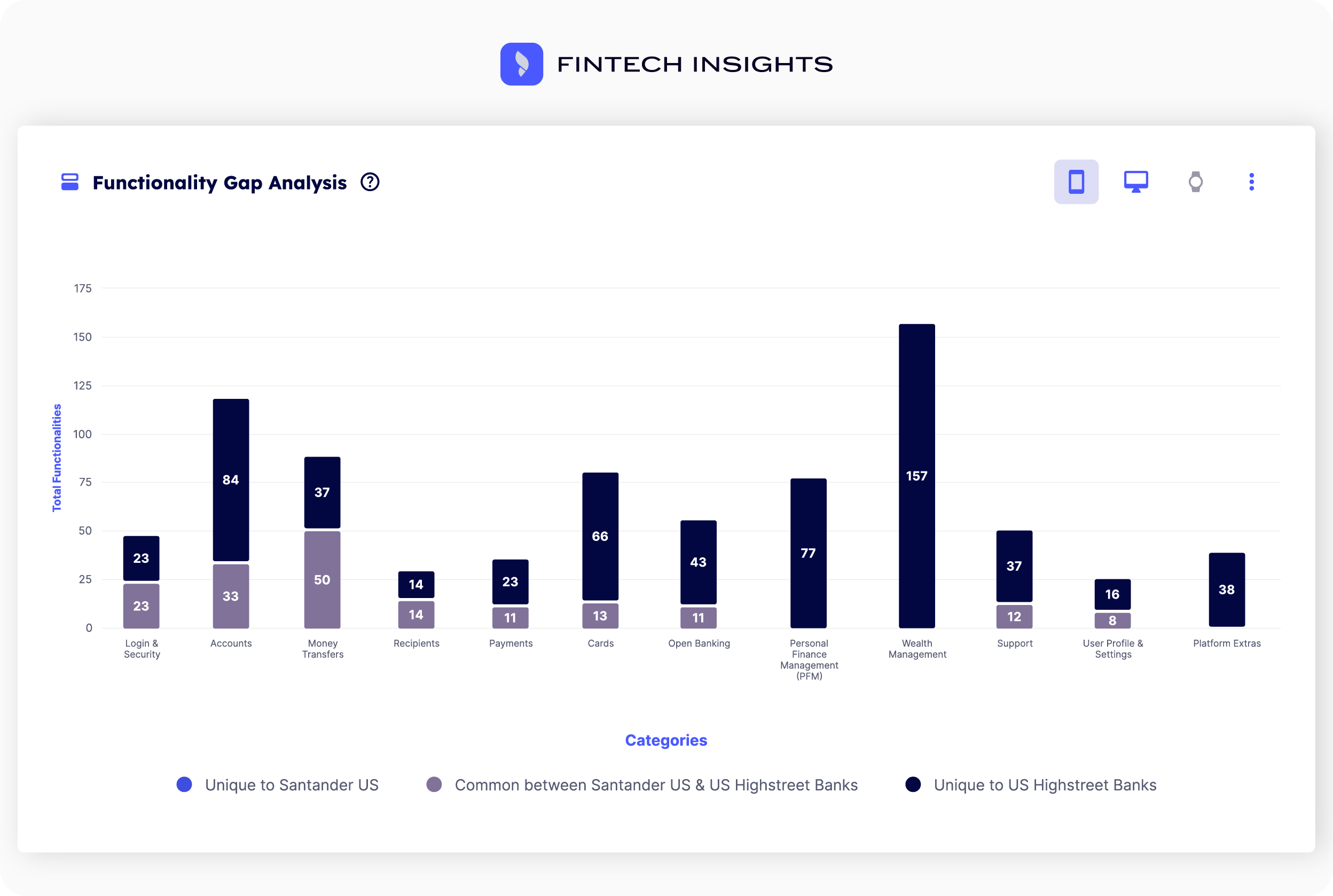
As you can see in the gap analysis graph below, the data from our digital banking research platform FinTech Insights shows that Santander US doesn't have the critical functionality gaps that Monzo's US app had.
Must-have functionalities for the US market
Core functionalities that Monzo US lacked, but which Santander supports include:
- Overdraft management, including whether ATM transactions and one-time debit card purchases can overdraw the customer's account
- Remote deposit capture
- P2P transfers via Zelle
- FDIC-insured deposits
- Online bill payments
- Applying for a credit card online. Though Santander only supports this on the web, it's still an advantage over Monzo US, which didn't support them at all, since credit cards are the most popular cashless payment method in the US
Functionalities supported through alternative channels
While not supported on the mobile app itself, Santander US customers can also access:
- Certificates of deposit. These are generally opened in person at a physical branch and subject to a $500 minimum deposit
- Private client wealth management services (subject to minimum investment thresholds)
- Car finance via Santander Consumer USA, which is a separate entity from Santander US' retail banking arm
Areas for improvement
It's worth noting that, compared to other competitors, Santander US' app doesn't have any unique features. It also lacks personal finance management tools and card cashback features, two increasingly important competitive differentiators.
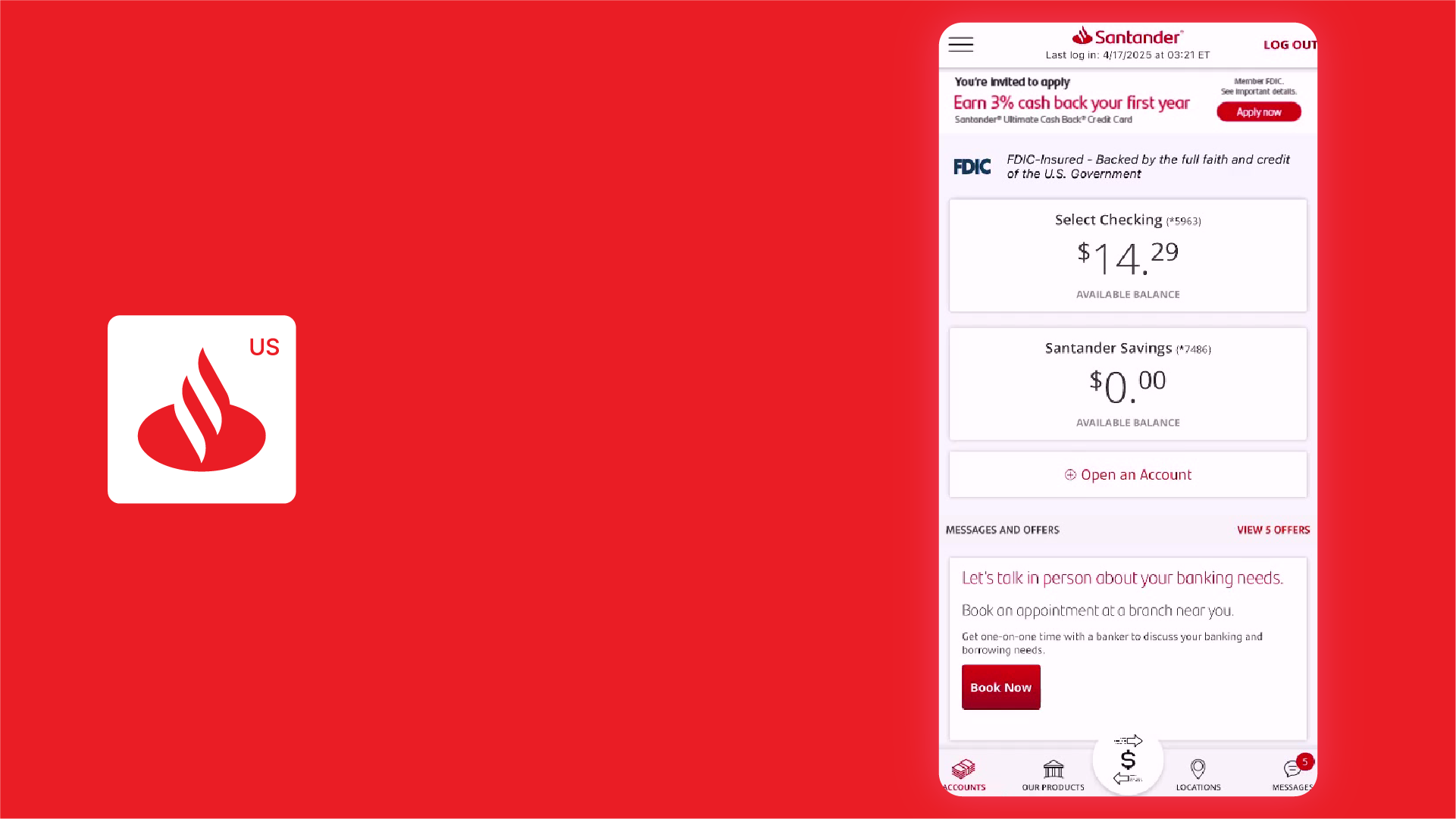
Their app's UI is also relatively understated — nothing like the polished look popularized by Monzo and other European fintechs.
The absence of such features however, don't seem to have impacted Santander's profitability.
For European banks to succeed in the US, they must work out how to deliver what consumers want
Santander's success in the US is no accident, but the result of a carefully executed strategy.
Rather than trying to launch their European model wholesale right out of the gate, Santander took the longer, more strategic route, gaining experience in Latin America before expanding to the US.
Just as important, instead of wrestling with the US market's uniquely complex regulatory framework, the bank found a way through.
For Santander, this meant building local capabilities through acquisitions. The bank bought established infrastructure, then rebranded the buildings and integrated their back-end technology.
For other European banks, the path will likely look different, depending on their situation. But the core lesson doesn't change. The US' highly competitive and fragmented market is its own beast, and must be approached accordingly. The basics are what matters most, and European banks can't hope to succeed unless they find a viable way to deliver them.
Want to dive deeper into the US digital banking market?

Build a digital banking strategy that can't be challenged
Let's show you how FinTech Insights can help you wow your customers, on every login.