

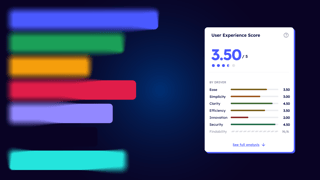
Our New UX Methodology:
The 7 UX Drivers
The key differences between the Perfect 1000 scoring model and the 7 UX Drivers methodology are how user journeys are assessed and how the results are presented.
In the Perfect 1000 scoring model, each user journey starts with a score of 1000. Points are then deducted based on how simple or complicated the journey is.
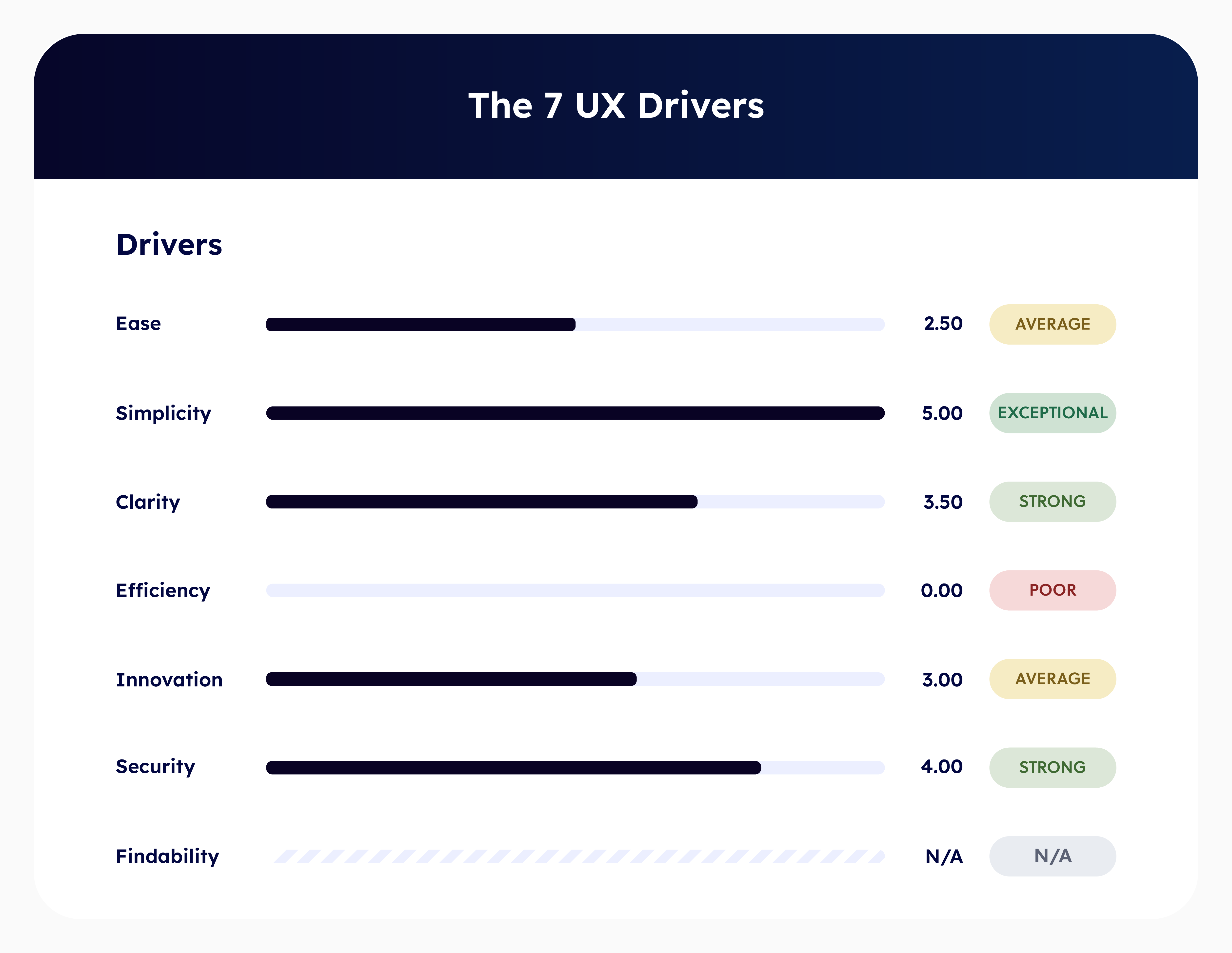
The 7 UX Drivers approach, on the other hand, scores each driver between 0 and 5, with the overall score representing the average. These drivers are: ease, simplicity, clarity, efficiency, innovation, security, and findability.
Not every UX Driver is applicable to every user journey, and a user journey's overall score is based solely on those drivers that apply to it.
1. Ease
This measures how easily users can complete a journey with minimal actions.
An effortless journey minimizes the number of actions required, such as typing, data entry, document uploads, and clicks, reducing the amount of work users need to complete a task.
2. Simplicity
This assesses how smoothly users can complete a journey without encountering unnecessary obstacles.
A simple journey minimizes friction by avoiding unnecessary steps, repeated requests for the same information, and other obstacles that make the process more demanding than it needs to be.
3. Clarity
This quantifies the mental effort required to understand and complete the journey.
It takes into account how much and how often the user needs to pause, think, or work out what to do next.
User journeys that include elements designed to reduce the user's cognitive load, such as progress indicators and step-by-step instructions, get a higher score. Overwhelming screens, complex language, or navigation that leaves users unsure what they need to do next leads to a poorer score.
4. Efficiency
This aspect reflects whether the process is completed instantly or there are delays caused by bank reviews. Such delays prevent a journey from being completed immediately, because they make completing an action unnecessarily complex or time-consuming.
5. Innovation
This criterion examines how innovative banks are in shaping everyday user journeys. It assesses how banks enhance traditional processes by incorporating new technologies, creative features, or improved digital solutions that make daily banking tasks more efficient, convenient, and user-friendly. Some examples include scanning options and autofill fields, quick transfers etc.
6. Security
This assesses the strength of the authentication methods and processes used to secure a specific journey.
Drawing on our expertise, we categorize authentication methods and security features from most to least secure. At the most secure end of the spectrum are biometric authentication, such as Face ID, Touch ID and video selfies. At the least secure end are relying solely on a PIN or username and password.
7. Findability
This evaluates how quickly and easily the typical user can locate key features.
User journeys score higher on this UX Driver when the layout, labelling, and navigation feel intuitive enough that the average user doesn't have to search extensively or try and guess where things are.
More clarity. Deeper insights. Better results.
The 7 UX Drivers methodology makes UX performance easier to understand and act on:
- More simplicity. The five-point scale makes each Driver’s performance clearer and more accessible at a glance. We've also replaced the Perfect 1000 flowchart with more streamlined visualisations
- More transparency. Instead of seeing only an overall score, you have visibility into how every applicable driver contributes to a user journey's UX performance
-
Easier to action. Seeing performance across every applicable UX driver makes it easier to identify a user journey's strengths and weaknesses, allowing banks to pinpoint exactly where it performs well and where improvements are needed. For example, a journey may require little effort but still be difficult for users to find in the first place.
The 7 UX Drivers also give you a more detailed and holistic picture of every user journey.
And in a highly competitive market this added visibility can help you identify where focused changes could make the most meaningful difference to the customer experience.
Want to learn more about how FinTech Insights can help you identify and use best practices to deliver better UX?

Build a digital banking strategy that can't be challenged
Let's show you how FinTech Insights can help you wow your customers, on every login.