

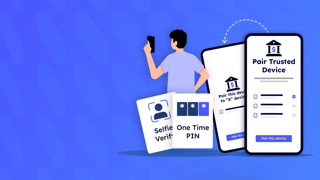
A uniform approach
Our analysis — this focused solely on mandatory steps and excluded skippable ones — revealed that credit unions approach the pair device process in very similar ways.
60% of our sample — 21 firms — require a username, password, and OTP (one-time password). A handful of firms vary the process slightly or add one or more steps on top, but none are particularly distinctive:
- Username — password — create PIN (as a quicker login alternative) — confirm PIN
- Username — password — verify you're human
- Username — password — verify you're human — OTP
- Username — password — create PIN — confirm PIN — OTP
- Username — password — authorize device. Here, the user receives a push notification to the previously paired device. This approach in particular can add significant (and avoidable) friction, because if the old device is no longer available, the user has to log on to their bank's web portal and manually remove it from their account.
16.7% of the firms in our data set also ask the user to give their device a nickname, or alias, which helps them identify devices more easily and prevent confusion during future device management on the platform.
The minority approach — used by 5.7% of the credit unions in our sample — requires a username and password only. No OTP or further verification.
According to Security.org, around 77 million Americans experienced an account takeover in 2024.
The data doesn't specify how many of these takeovers were of bank or credit union accounts. That said, it still highlights how risky the latter approach is. Should their login credentials get leaked, there's no failsafe stopping bad actors from logging on.
But is the majority approach of username, password, and OTP — or a variation on the above — best practice? Or are there better ways to tackle device-pairing?
How banks and challengers approach device-pairing
A look at the wider US market isn't particularly illuminating.
The 25 banks and challengers we analyzed for comparison approach device pairing in much the same way as credit unions: username and password, sometimes (but not always) supplemented by an OTP or other basic authentication methods.
The EU-UK market, on the other hand, is a different story, with several examples of clever, out-of-the-box thinking that enhances security without adding significant friction to the process.
Let's have a look at what, in our view, are the three stand-out examples from a data set of 36 banks and challengers.
Bunq
The Amsterdam-based challenger's approach to device-pairing incorporates a selfie.

The user takes the selfie within the bunq app. This both minimises friction and makes the process more secure as, unlike an OTP, there's no risk that the selfie will be intercepted by bad actors.
Monese
UK-based Monese replaces the selfie requirement with a short video.

As with a selfie, a video is harder to intercept than an OTP or other off-app verification. And, because the video captures movement, it's harder to spoof than a selfie but doesn't add measurable friction to the process.
Monzo
Monzo forgoes the selfie or video and, instead, asks the user to upload proof of ID, such as a passport or driving licence.

This method introduces the most friction, because the user will need to have a valid ID document handy. If they don't have access to any of the four documents Monzo accepts, this will delay the process.
One small step for US credit unions, one giant step towards better security and UX
Broadly speaking, the majority approach to device pairing among US credit unions — username, password, additional verification step — is in line with that of US challengers and incumbents, and with the approach of EU and UK banks and challengers too.
But it's the last step — additional verification — that can make all the difference.
NIST — the US National Institute for Standards and Technology — is openly critical of one-time passwords via SMS, due to the increasing incidence of SIM-swap fraud.
But, with phishing and other social engineering scams also on the rise — in 2024, they were up by 94% over 2023 — even OTPs via email are a risky proposition.
Against this backdrop, our view is that the best choice overall is to use a username — password — selfie, for three reasons:
- It adds an additional layer of security. Even if a bad actor were to successfully log on to the user's account and take over their SIM and email, they'd need to be able to submit a convincing selfie matching the user's official ID, in order to pair the device
- It's quicker and easier than filming a video or uploading a passport, driving licence, or other ID document
- It doesn't force the user to leave the app
Of course, the rising incidence of deepfake AI — highly realistic, artificially generated videos and images — means that, over time, selfies and videos will also no longer be secure enough on their own.
It will be interesting to see how the firms that are ahead of the curve will approach deepfake-proofing while minimizing friction.
Want to dig deeper into US credit unions' onboarding and device-pairing processes?

Build a digital banking strategy that can't be challenged
Let's show you how FinTech Insights can help you wow your customers, on every login.